Guide to Adit Notifications
Adit Voice makes it super easy to manage and view your missed calls, voicemails, eFaxes, and all of your notifications in one place.
How to Quickly View Your Phone Notifications.
Call Pop. When logged into the homepage of your dashboard, you can check your call logs, missed calls, voicemails, and eFaxes by simply clicking on the Call Pop Icon on the top bar.

In the Call Pop, switch between the different tabs by clicking the icons at the top. They are labeled as follows:
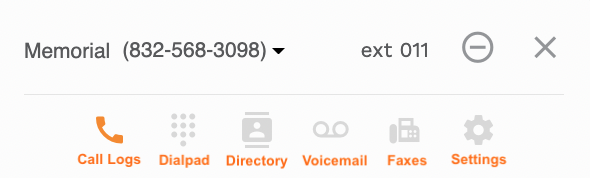
Please note, if you have not set up Adit Voice then the dialpad, directory, and settings icons will not show.
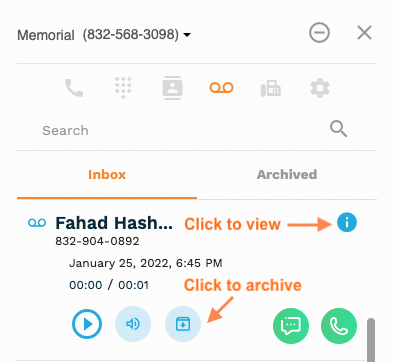
Voicemails. When you check a voicemail in the Call Pop, that voicemail will be marked as READ. You can then choose to ARCHIVE that voicemail by clicking the Archive button.
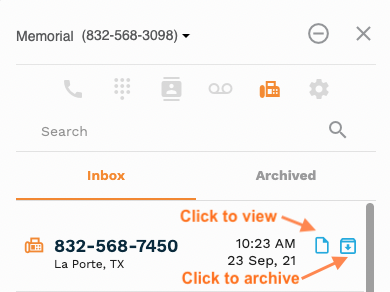
Faxes. The same settings apply to Faxes. When you view a Fax, it is marked as Read. You can then choose to Archive a Fax.
Call Tracking. The call tracking module can be used to listen to any recorded calls, all historical voicemails, and see all eFaxes. While Call Tracking is a great module to find all of your history and insights, it isn’t made for your daily use. We recommend the Call Pop for checking your phone notifications daily.
How to See Your Notifications When in the App
When logged into the platform, Adit makes it simple for you to constantly see all of your notifications and to-do items in one place. Here is how it works:
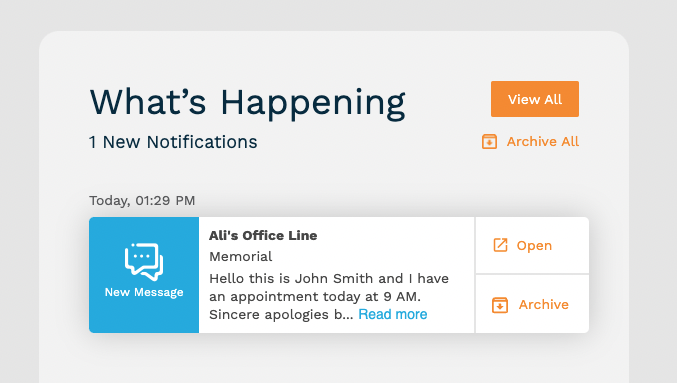
The What’s Happening Section. The “What’s Happening” section on your home page shows all of your unread notifications across the app. You can quickly see everything here and quickly mark things as read accordingly. There are two tabs for Practice Notifications and "My Notifications"
- Practice Notifications (This is where you'll see the usual notifications for the practice like appts, forms, payments, calls, etc.)
- My Notifications (this will only show user specific notifications like internal chat messages and follow ups)
- Practice Notifications (This is where you'll see the usual notifications for the practice like appts, forms, payments, calls, etc.)
Orange Dots. The orange dot represents if there are any unread items in any of your modules or calls. To view these items, simply click on the module and mark the line item as Read. These items can include:
Unread text messages (Engage module)
Unread voicemails (Call Pop)
Unread faxes (Call Pop)
Missed calls (Call Pop)
Unread form submissions by patients (Patient Forms module)
Unread appointment requests (Online Scheduling module)
Unread contact us submission (Online Scheduling module)
Unread payment received alert (Adit Pay module)
Unread payment disputes alert (Adit Pay module)
Unread Chats (Internal Chat Module)
Follow Up Due Reminders (Practice Analytics Module)

How to Be Alerted of New Notifications
Simply said, there are 4 ways to be alerted of a notification.
Desktop notifications (preferred)
Mobile notifications
Email notifications
Browser notifications (not preferred)
To understand which of these notification options best fits your daily workflows, please read below:
Desktop Notifications. We recommend that your staff set up Desktop Notifications on each of their computers. The benefit to the Desktop Notification App is that your staff can be alerted in real-time of inbound calls, missed calls, appointment requests, and so much more. To set this up, please refer to Set up desktop notifications.
Mobile Notifications. You can receive mobile notifications using Adit’s mobile app on your iPhone or Android device. This usually works well if you aren’t situated at a desk all day and need to be alerted when out of the office. (Example: emergency calls after hours or if you want to stay engaged during your lunch break). To set this up, please refer to Set up mobile notifications.
Email Notifications. You can receive notifications to your email as well from Adit. This usually works best for operations managers and doctors that want to be alerted of specific activities that may happen through the course of a day (ex: Missed Calls). Another use-case for email notifications is if your staff looks at their email inbox all day and wants to be alerted there of any new form submissions or appointment requests. To set this up, please refer to Set up email notifications.
Browser Notifications. Browser notifications are easy to set up but many times can be delayed because of different tabs and processes running on your browser. We do not recommend enabling browser notifications unless notifications are not a time-sensitive need for your daily use-case. Browser notifications are usually used by an off-site staff member that wants to stay engaged but is not responsible for picking up calls. To set up Browser notifications, please refer to Set up browser notifications.